

Baltimore is one of those cities whose name arrives with a storied history already attached. You may have heard that it’s the birthplace of The Star-Spangled Banner, the home of baseball legend Babe Ruth or the Maryland city with a waterfront shaped by centuries of maritime activity, brick row houses, neighbourhood taverns, blue crabs dusted with seasoning, and an enormous red-brick warehouse overlooking Oriole Park at Camden Yards. And all of that is true. But there’s so much more.
Like many great cities, Baltimore has continued to evolve while holding onto the people, places and traditions that made it distinctive in the first place. It’s also a city of surprising firsts—from the oldest continually operating public market in the United States to the nation’s first monument dedicated to George Washington—reminders that Baltimore has shaped American history in ways many visitors never realize.

Baltimore’s Washington Monument was completed in 1829. Today you can still climb the 277 steps and get a priceless panoramic view of Charm City. Photo: Baltimore.org.

Set along Maryland‘s waterfront, Baltimore developed around a harbour that connected the city to trade, transportation and the wider Chesapeake Bay region. Railways later strengthened those connections, helping move goods and people between Baltimore’s port, the American interior and destinations across the continent. That history remains visible today—in former industrial buildings, historic ships, cobblestone streets and neighbourhoods whose identities have been shaped by generations of residents, workers, artists and entrepreneurs.
Today’s Baltimore isn’t simply preserving its history—it’s using it to shape what’s next.
Spend even a day exploring the city and you’ll quickly discover that Baltimore’s greatest charm lies in its contrasts. Historic warehouses have found new life as restaurants, hotels, shops and gathering places. Once-industrial districts now invite you to browse independent boutiques, linger over brunch or discover public art around nearly every corner. Among the most ambitious examples is the Baltimore Peninsula, where a former industrial landscape is being reimagined as a lively neighbourhood filled with restaurants, residences, green spaces and places to gather. From the cobblestone streets of Fell’s Point and the views from Federal Hill to the energy of Harbor East and the Inner Harbor, each neighbourhood offers its own personality and its own reason to stay a little longer.
From working waterfront to walkable neighbourhood, Baltimore Peninsula showcases the city’s ongoing waterfront revival. Photo: BaltimorePeninsula.com

If you enjoy discovering a city’s creative side, Baltimore won’t disappoint. The National Aquarium is one of the city’s signature attractions, while the American Visionary Art Museum celebrates the imagination of self-taught artists in ways that are both inspiring and delightfully unconventional. Beyond the museums, you’ll discover colourful murals, live music, neighbourhood festivals and independent makers that give Baltimore a creative energy rooted in its communities rather than created for tourists.
Thoughts From the Deep, created by Canadian artist Ho Baron, is among the thought-provoking works showcased at the American Visionary Art Museum. Photo: Faze.

Perhaps that’s what makes a trip to Baltimore so appealing today. It’s a city that feels comfortable in its own skin—confident enough to celebrate its history while continuing to reinvent itself through art, food, neighbourhoods and the people who give each corner its own character.
One of the best ways to experience Baltimore is through its food. Of course, you’ll find Chesapeake seafood and the famous Maryland blue crab, but the city’s culinary scene stretches far beyond tradition. Historic markets, neighbourhood cafés, chef-driven restaurants and the revival of Maryland rye whiskey all reflect a city that’s proud of its roots while continuing to reinvent itself. Whether you’re looking for an unforgettable brunch, dinner overlooking the water or a locally crafted spirit, Baltimore offers plenty to savour.
Chesapeake Bay blue crabs aren’t just a local delicacy—they’re a cultural symbol of Maryland, where crab feasts have been a summertime tradition for generations. Photo taken at Nick’s Fish House: Faze.

Even if you’re not a baseball fan, don’t overlook Oriole Park at Camden Yards. Designed around the historic B&O Railroad warehouse, the ballpark transformed the way modern baseball stadiums are built, inspiring a new generation of parks across North America. Today, it’s as much an architectural and cultural landmark as it is a sports venue—and one more example of Baltimore’s remarkable ability to honour its past while embracing its future.
Faze had the chance to explore Baltimore’s neighbourhoods, attractions and culinary scene—and we weren’t disappointed.
Where We Went
National Aquarium
Regularly ranked among North America’s best, the National Aquarium is home to more than 20,000 animals, but the true showstopper is the award-winning Blacktip Reef. This spectacular 260,000-gallon coral reef habitat surrounds you with sharks, rays, sea turtles and hundreds of brilliantly coloured tropical fish, creating one of the aquarium’s most unforgettable experiences. While there, don’t miss the immersive Tropical Rain Forest, where lush greenery, waterfalls and free-flying birds make you feel as though you’ve stepped into another world.
From sharks and rays to living coral, the National Aquarium showcases the remarkable diversity of marine ecosystems. Photo: Faze.

Lush vegetation and towering rock formations transport you from Baltimore’s Inner Harbor to the heart of a tropical rainforest. Photo: Faze.

With their graceful, pulse-like movements, moon jellies are among the National Aquarium’s most mesmerizing residents. Photo: Faze.

Watermark Sightseeing Cruise
One of the best ways to experience Baltimore is from the water. The 45-minute narrated Watermark Sightseeing Cruise offers a fresh perspective on the city, weaving together its maritime history with its modern-day renaissance. As you glide through the Inner Harbor, you’ll pass landmarks including Fort McHenry, the iconic Domino Sugar sign and the Under Armour headquarters, while taking in views of neighbourhoods such as Federal Hill, Fell’s Point and Harbor East. It’s a relaxing way to appreciate how Baltimore’s past and present come together—and to see why the waterfront remains at the heart of the city’s identity.
A cruise through the Inner Harbor showcases the waterfront that has defined Baltimore’s story for nearly 300 years. Photo: Watermarkjourney.com.

American Visionary Art Museum
If you’re looking for an art museum unlike any you’ve visited before, make time for the American Visionary Art Museum. America’s official national museum for self-taught and intuitive artists celebrates creativity in its most imaginative forms, from whimsical sculptures and intricate mosaics to thought-provoking mixed-media installations. Before you even step inside, take time to admire the museum’s dazzling mirrored mosaic exterior—created in partnership with Baltimore youth—which has become one of the city’s most photographed landmarks. Don’t miss the iconic Giant Golden Hand and Cosmic Galaxy Egg sculptures outside, then head indoors to explore ever-changing exhibitions that prove great art doesn’t always come from formal training—it often comes from extraordinary imagination.
Long before you step inside, the museum’s mosaic-covered façade signals that this is anything but a traditional art museum. Photo: Faze.

Unexpected sculptures greet visitors throughout the museum grounds, reinforcing the idea that inspiration can be found anywhere. Photo of Cosmic Egg: Faze.

Artist Devon Smith transformed discarded household objects into The World’s First Robot Family—proving that imagination is the ultimate recycling tool. Photo: Faze.

Sagamore Spirit
Whether you’re a whiskey enthusiast or simply curious about one of Maryland’s signature spirits, Sagamore Spirit offers an engaging look at the state’s rich rye whiskey tradition. Guided tours take visitors through the distilling process—from grain to glass—before concluding with a tasting of its award-winning rye whiskies. Opened in 2017, the striking five-acre waterfront distillery was created to help revive Maryland rye, a whiskey style that nearly disappeared after Prohibition but once helped define American whiskey. The distillery has earned more than 200 international awards, including the title of World’s Best Rye Whiskey at the 2019 San Francisco World Spirits Competition. Even if whiskey isn’t your drink of choice, the modern distillery is worth visiting for its architecture, scenic location in Baltimore Peninsula and fascinating insight into one of the state’s most enduring traditions.
From Signature Rye and Double Oak to Cask Strength and limited releases, Sagamore Spirit’s lineup showcases the versatility of Maryland rye whiskey. Photo: Faze.

Rising 40 feet above the distillery floor, the world’s only mirror-finished copper column still forms the striking centrepiece of Sagamore Spirit’s whiskey-making operation. Photo: Faze.

Presented side by side, Sagamore Spirit’s rye whiskies demonstrate how choices such as proof, maturation and barrel finishing can dramatically change aroma and flavour. Photo: Faze.

Oriole Park at Camden Yards
You don’t have to be a baseball fan to appreciate Oriole Park at Camden Yards. When it opened in 1992, it revolutionized ballpark design by moving away from the concrete, multi-purpose stadiums of previous decades and embracing a more intimate design rooted in the character of its city. Much of that vision was championed by Janet Marie Smith, an architect and urban planner who became one of the first women to hold a senior executive role in Major League Baseball. Rather than creating a stadium that could have belonged anywhere, Smith helped shape one that belonged unmistakably to Baltimore.
The historic B&O Railroad Warehouse was preserved as part of the ballpark experience, while Eutaw Street continued through the complex as a lively pedestrian concourse. Hand-laid red brick, cast-iron gates and exposed steel trusses echoed the architecture of Baltimore’s industrial buildings and the urban ballparks of an earlier era, while asymmetrical field dimensions and vintage-inspired details gave the thoroughly modern stadium a sense of history and place. Its influence was so profound that Camden Yards became the blueprint for a new generation of Major League ballparks across North America.
More than three decades later, Camden Yards continues to evolve. Recent renovations include a spectacular new centre-field videoboard measuring two-and-a-half times larger than its predecessor, 4K LED ribbon boards throughout the stadium, an upgraded sound system, renovated club spaces, new fan gathering areas and enhanced food and hospitality experiences—all while preserving the charm and character that made the ballpark famous. The new Truist Club offers one of the most coveted views in baseball. Opened as Camden Yards’ first premium club, the 350-seat space combines all-inclusive dining with an unmatched behind-home-plate perspective of the game. Whether you catch an Orioles game or simply tour the grounds, Camden Yards remains one of Baltimore’s must-see landmarks and a destination that continues to set the standard for the fan experience.
Floor-to-ceiling glass in the new Truist Club places you just steps from the action while offering sweeping views of the field, scoreboard, and the iconic B&O Warehouse beyond right field. Photo: Faze.

Whether you’re grabbing a bite, ordering a drink or charging your phone, thoughtfully designed social spaces throughout Camden Yards let you stay connected to the action without missing a pitch. Photo: Faze.

Stretching 1,116 feet along Eutaw Street, the restored B&O Railroad Warehouse is one of the longest brick buildings on the U.S. East Coast and the architectural centrepiece of Camden Yards. Photo: Faze.

Even the ornate seat ends reflect Janet Marie Smith’s guiding principle that every detail of Camden Yards should feel rooted in Baltimore’s history, giving the ballpark an authentic sense of place. Photo: Faze.

Babe Ruth Birthplace & Museum
Even if you couldn’t tell a fastball from a curveball, the Babe Ruth Birthplace & Museum is worth a stop. Located just a long fly ball from Oriole Park at Camden Yards, the modest Baltimore row house where George Herman “Babe” Ruth was born in 1895 offers an intimate look at the childhood of one of baseball’s greatest icons. Spoiler alert—you’ll learn the nickname “Babe” came about after the teenage Ruth joined professional baseball, where reporters dubbed him “Jack Dunn’s baby” because of his young age. Rather than focusing solely on his legendary career, the museum tells the story of a boy from a working-class neighbourhood whose larger-than-life personality and determination helped shape American sports history. Interactive exhibits, personal memorabilia and stories from his early years make the experience surprisingly engaging, even for visitors who don’t consider themselves baseball fans. Saved from demolition in the late 1960s and reopened as a museum in 1974, the home stands today as both a tribute to Babe Ruth and a reminder that extraordinary journeys often begin in the most ordinary places.
Preserved much as it would have appeared in the late 1800s, Babe Ruth’s childhood home brings Baltimore’s history to life one room at a time. Photo: Faze.

Long before athlete endorsements became commonplace, Babe Ruth was transforming his fame into one of the first personal brands in professional sports. Photo: Faze.

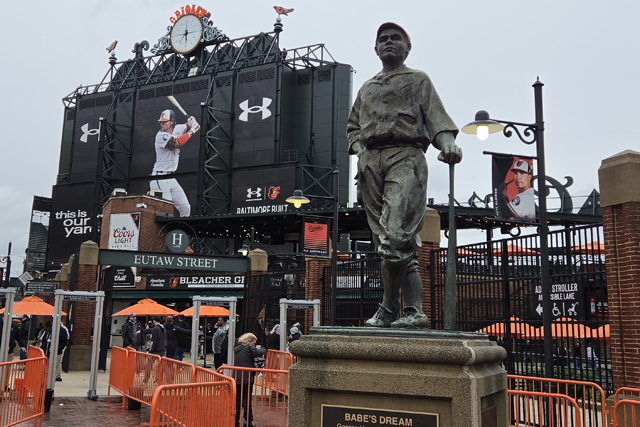
The ‘Babe’s Dream’ statue outside Oriole Park at Camden Yards pays tribute to the early years of “Babe” Ruth, whose remarkable journey began just blocks away. Photo: Faze.
Where We Ate
Miss Shirley’s Café
No visit to Baltimore is complete without breakfast at Miss Shirley’s Café, a local favourite that has earned national recognition for its creative take on Southern-inspired and Chesapeake cuisine. Expect generous portions and a menu that celebrates regional flavours, from its famous crab dishes to indulgent French toast and inventive brunch classics. Whether you’re fuelling up for a day of sightseeing or lingering over a leisurely weekend brunch, the warm hospitality and vibrant atmosphere make Miss Shirley’s a Baltimore institution that’s well worth the wait.
Miss Shirley’s Café has earned a loyal following by pairing Chesapeake Bay ingredients with Southern flavours, creating a menu that feels distinctly Maryland. Photo: MissShirleys.com.

Miss Shirley’s Chicken ‘N Cheddar Green Onion Waffles have become one of Baltimore’s best-known brunch dishes, earning a spot on Food Network’s Diners, Drive-Ins & Dives. Photo: Faze.

Whether you’re craving sweet, savoury or somewhere in between, Miss Shirley’s extensive menu—including one of Maryland’s largest gluten-free brunch selections—offers something for virtually every palate. Photo: Faze.

Nick’s Fish House
If you’re looking for an authentic taste of the Chesapeake, Nick’s Fish House is the kind of place locals recommend. Situated on the banks of the Patapsco River just minutes from downtown Baltimore and conveniently close to ROOST Baltimore, this laid-back waterfront restaurant is known for serving fresh Maryland seafood in a relaxed marina setting. Whether you’re craving Maryland crab cakes, steamed blue crabs (when in season), oysters, shrimp or fresh fish, Nick’s celebrates the region’s rich seafood traditions. It’s easy to see why the restaurant earned top honours in The Baltimore Sun’s 2025 Readers’ Choice Awards for Best Raw Bar, Best Cocktails, Best View and Best Outdoor Dining. Grab a table on the outdoor deck, watch the boats drift by and enjoy one of those quintessential Baltimore dining experiences that perfectly captures the city’s connection to the water.
For more than two decades, Nick’s Fish House has been a favourite gathering place where locals and visitors come together to enjoy Maryland seafood, live music and waterfront views. Photo: Faze.

Nick’s Chesapeake Crab Balls prove that sometimes less is more—bite-sized portions packed with the sweet, delicate flavour that has made Maryland blue crab famous. Photo: Faze.

Rye Street Tavern
Located along the revitalized waterfront in Baltimore Peninsula, Rye Street Tavern combines Chesapeake-inspired cuisine with spectacular harbour views. Opened in 2023, the restaurant has quickly become one of the neighbourhood’s signature dining destinations. At the heart of the kitchen is an impressive wood-fired hearth, where many of the restaurant’s seafood, meats and seasonal vegetables are prepared over an open flame. Leading the culinary vision is acclaimed chef John Shields, a multiple-time James Beard Award nominee whose decades-long career has helped define and preserve the flavours of the Chesapeake. The menu celebrates Maryland’s culinary heritage through locally sourced seafood, seasonal ingredients and expertly crafted wood-fired dishes. If the weather cooperates, request a table outside to enjoy the waterfront views while watching boats pass through the harbour.
Rye Street Tavern’s menu changes with the seasons, reflecting the availability of fresh seafood from the Chesapeake and produce sourced from regional farms. Photo: RyeStreetTavern.com.

More than just outdoor seating, Rye Street Tavern’s waterfront patio was designed as an extension of Baltimore Peninsula’s public promenade, connecting diners with the harbour beyond. Photo: RyeStreetTavern.com.

Where We Stayed
ROOST Baltimore
If traditional hotel rooms feel a little too predictable, ROOST Baltimore offers a refreshing alternative. Blending the comfort of a contemporary apartment with the service of a boutique hotel, each suite features a full kitchen, spacious living area and in-suite laundry, making it easy to settle in and experience Baltimore more like a local than a tourist. Thoughtfully designed with original artwork, handmade furnishings and living plants, the accommodations feel warm, stylish and unmistakably residential rather than corporate.
Located on the revitalized Baltimore Peninsula waterfront, ROOST is within walking distance of Nick’s Fish House, Sagamore Spirit, Rye Street Tavern and scenic harbour trails. After a day of sightseeing, you can unwind beside the rooftop pool overlooking the Patapsco River and grab a snack at Little Wing, the property’s inviting café and artisan market. More than a typical hotel coffee shop, Little Wing serves pastries from Baltimore’s acclaimed Kneads Bakeshop and a thoughtfully curated selection of locally made goods. Together with the apartment-style suites, it reinforces the feeling that you’ve found a stylish home base rather than simply checked into a hotel.


Comments are closed.