

Table of Contents
- AI-Powered Underwriting
- Blockchain and Tokenization
- Green Financing Initiatives
- Dynamic Pricing Models
- Comprehensive Data Platforms
- Conclusion
Commercial real estate financing has entered a transformative era, with technology and sustainability paving new paths for investors and developers. Traditional financing methods, once considered the backbone of real estate investment, are now being enhanced—and in many cases, reimagined—by innovative tools and approaches that better align with the evolving dynamics of today’s marketplace. For those looking to maximize opportunity, working with commercial mortgage brokers near me can help simplify these complex new offerings and put the latest advancements within reach.
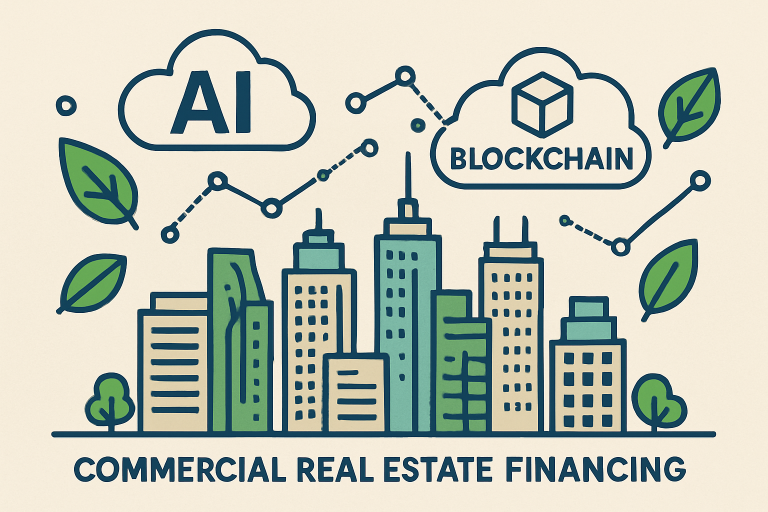
From AI-driven underwriting and blockchain tokenization to green financing and data-driven platforms, cutting-edge strategies are resetting expectations for speed, transparency, and sustainability across the sector. As competition grows and investor needs diversify, leveraging these creative financing trends will be pivotal to success in the modern CRE landscape.
With market disruption accelerating, the challenge is no longer just access to capital, but finding the most effective pathways to deploy it. Adapting to this new reality requires an understanding not only of the tools now available but also of their far-reaching impact on everything from transaction security to portfolio resilience. Recent research and industry developments, as reported by leading sources such as Forbes, underscore the rapid convergence of these innovations to transform the market.
AI-Powered Underwriting
Artificial Intelligence (AI) is at the forefront of streamlining the underwriting process in commercial real estate. By automating data collection, risk assessment, and property appraisals, AI enables faster processing of loan applications and reduces administrative overhead. Platforms such as Smart Capital demonstrate how AI can transform previously tedious manual calculations into instantaneous risk profiles, providing both lenders and borrowers with a new level of transparency and speed. This technology also helps reduce human error, facilitating an environment where lenders can confidently deploy more accurate, data-driven decisions.
Moreover, machine learning models continuously improve as they process more transactions, meaning their predictive power strengthens with time. According to The Wall Street Journal, the growing adoption of AI isn’t just about speed; it’s about turning scattered data points into actionable intelligence, which has proven to increase the reliability of loan approvals and enhance risk mitigation strategies across the industry.
Blockchain and Tokenization
Blockchain technology is making significant inroads in commercial real estate by introducing greater transparency and security to property transactions. Through tokenization, properties can be divided into digital shares, each represented and traded via blockchain. This method allows both high-net-worth and retail investors to purchase fractional ownership in commercial real estate, effectively democratizing access to deals that were previously limited to institutional players.
Platforms like RealT are pioneers in this domain, leveraging blockchain to facilitate direct, low-friction transactions and to maintain immutable records of ownership changes. Tokenization also opens secondary markets, enhancing property liquidity and providing sellers with new ways to access capital more rapidly. The entire investment process is becoming more transparent, auditable, and accessible to a globe-spanning cohort of potential investors.
Green Financing Initiatives
Amid growing concerns about climate change, green initiatives now play a central role in investment decisions. Leading asset managers, such as Tom Steyer’s Galvanize Climate Solutions, are allocating billions to transform U.S. commercial projects into more energy-efficient and environmentally responsible buildings. The focus is not only on improving a property’s carbon footprint but also on creating a distinct asset class that meets both investment returns and sustainability mandates.
Green bonds and other sustainability-linked financing vehicles are rapidly gaining traction, driven by an increasing appetite among investors for eco-friendly assets. According to reporting from The New York Times, this trend has begun to reshape CRE investment portfolios and spark broader market innovation, with regulatory incentives and tenant demand accelerating this green transition.
Dynamic Pricing Models
The use of dynamic pricing models in commercial real estate has become a key strategy for maximizing project returns and aligning prices with real-time market conditions. By incorporating multiple variables—ranging from sales performance and project milestones to overall demand—long-term revenue streams can be optimized while minimizing vacant inventory.
Mathematical models designed for CRE offer greater agility in pricing, allowing for periodic adjustments that reflect changes in the economic environment. For sellers and developers, this means an enhanced ability to meet sales targets, while buyers benefit from more transparent, data-informed pricing. These flexible models are particularly valuable in volatile or highly competitive markets where static pricing can leave significant value on the table.
Comprehensive Data Platforms
The proliferation of all-in-one data platforms has revolutionized access to critical information for both CRE financiers and investors. By unifying sales comparables, transaction histories, financing details, and operational metrics into a single, user-friendly interface, these platforms save both time and money—often eliminating the need for multiple expensive subscriptions.
Such comprehensive data visibility allows for faster due diligence, more accurate forecasting, and a deeper understanding of local and national market conditions. This supports better decision-making, empowers brokers and investors to react swiftly to emerging trends, and increases the likelihood of achieving favorable investment outcomes.
Conclusion
As commercial real estate financing continues to evolve, emerging technologies are redefining how investments are structured, managed, and scaled. The integration of AI, blockchain, green funding, dynamic pricing models, and advanced data analytics is fostering more intelligent decision-making and enhanced transparency. These innovations streamline transactions, reduce costs, and expand market participation by bridging gaps between investors and opportunities. Early adopters gain a competitive edge through improved forecasting, efficient capital allocation, and more sustainable investment strategies. Collectively, these advancements are shaping a more agile, resilient, and forward-looking real estate ecosystem poised for long-term growth and stability.
Comments are closed.